

Alopecia Areata Treatment in Atlanta, GA: Restarting Growth in Patchy Hair Loss
Physician-led care that calms the immune attack and helps hair grow back in the patches.
- Common In:
- Children, teens and adults
- Primary Causes:
- Autoimmune, genetic, stress
- Treatment Time:
- 15-30 minute visits
- Results:
- Regrowth in 2-4 months

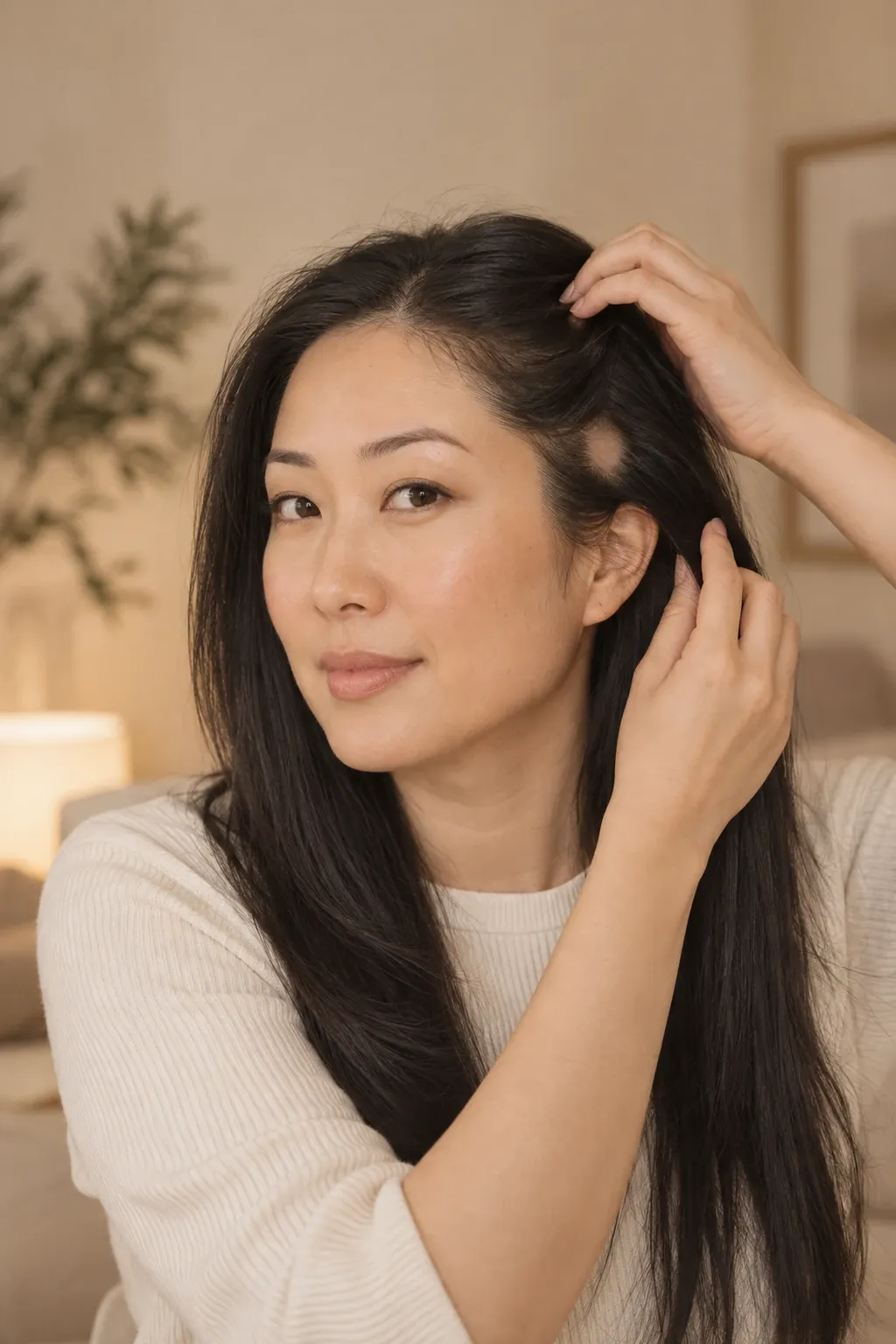
What Is Alopecia Areata?
Recognizing the Signs
Alopecia areata is an autoimmune condition in which the immune system attacks active hair follicles, pushing them into a resting state. The follicles are not destroyed, which is why hair can grow back. It typically causes smooth, round or oval bald patches on the scalp, beard, eyebrows or eyelashes, and in a smaller group of people it progresses to total scalp loss (alopecia totalis) or loss of all body hair (alopecia universalis).
When you find a coin-sized bare spot while styling, or a barber points one out, it is often the first sign. In straight and wavy hair the patch shows quickly; in curly and coily hair, braids, twists and fuller styles can hide it for weeks. On lighter skin the patch may look pink or peach, and on deeper skin tones it shows as smooth, slightly lighter or unchanged skin.
Alopecia areata affects people of every age, gender and background, and about 2 in 100 people develop it at some point. You are not alone, and with today's options most patients have a real path to regrowth. Explore every hair and scalp diagnosis we treat in our conditions library.
Medically reviewed by Dr. Nikki D. Hill, MD, FAAD. Last updated: October 2026.
Why Alopecia Areata Happens
Understanding the Root Causes
01The Science
A healthy scalp follicle spends 2 to 7 years in its growth phase, protected by what researchers call immune privilege, a shield that keeps immune cells from targeting it. In alopecia areata that shield breaks down. Cytotoxic T cells gather around the base of the follicle, signal through the JAK-STAT pathway, and switch growth off. The National Institute of Arthritis and Musculoskeletal and Skin Diseases describes it as an autoimmune disease with a strong inherited component.
Because the follicle stem structures survive, the hair can restart once inflammation settles. Treatment aims to quiet that immune signal long enough for growth to resume. Our medical hair loss treatment program pairs this approach with a full workup, so related problems such as thyroid disease or low iron are not missed.
02Deeper Understanding
How We Diagnose Alopecia Areata
How a Clear Diagnosis Guides Treatment
Diagnosis starts with a scalp exam and dermoscopy (trichoscopy), a magnified view of the follicles. Short broken hairs that taper toward the scalp, called exclamation point hairs, along with yellow dots and black dots, point toward alopecia areata. We also check the nails for pitting and look at the brows, lashes and beard.
Telling alopecia areata apart from look-alikes matters, especially in curly and coily hair. Traction alopecia from tight styles and central centrifugal cicatricial alopecia (CCCA) can mimic it but need very different care, and scarring forms of hair loss require early action to protect follicles. When the picture is unclear, a small scalp biopsy confirms the diagnosis.
Blood work may include thyroid studies, iron and vitamin D, guided by your history. A scalp coverage score at each visit measures regrowth objectively.
What Triggers Alopecia Areata Flares?
No single factor causes alopecia areata. Several influences tend to combine in a person who already carries a genetic tendency.
- 01Genetic TendencyUp to 1 in 5 people with alopecia areata has a close relative with it, and several immune-related genes raise susceptibility.
- 02Other Autoimmune ConditionsThyroid disease, vitiligo and type 1 diabetes occur more often alongside alopecia areata and can signal a more active immune system.
- 03Allergies and EczemaPeople with atopic dermatitis, asthma or hay fever tend to have earlier onset and more extensive or persistent patches.
- 04Physical or Emotional StressIllness, surgery, grief or major life changes often come shortly before a new patch, likely by stirring immune activity.
- 05Hormonal ShiftsPregnancy, postpartum changes and other hormonal transitions can coincide with flares or with spontaneous regrowth.

Why Choose SOCAH Center for Alopecia Areata Care in Atlanta, GA
Hair loss is the center of our practice. Dr. Hill, a nationally recognized hair loss specialist, leads every alopecia areata plan, sees children as young as 5 alongside teens and adults, and builds treatment around your hair type, styling routine and comfort with medical or holistic options. Patients visit from Tucker, Decatur, Brookhaven and across metro Atlanta.
- Board-Certified Hair Expertise
- Dr. Hill is a board-certified dermatologist with focused training in medical hair loss disorders.
- Every Hair Type and Age
- We treat straight to coily hair and evaluate children, teens and adults with the same careful approach.
- Full Range of Options
- Injections, topicals, immunotherapy and oral JAK inhibitors are matched to the extent of your hair loss.
- Measured Progress
- Scalp scoring and photos at each visit show what is working, so we adjust instead of guessing.

Treatment Options Comparison
These options are available through our hair loss program, and the right choice depends on how much hair is affected and your age.
| Care Program | Treatment Option | Best For | Results Timeline | Maintenance |
|---|---|---|---|---|
| Hair Loss Treatment | Intralesional corticosteroid injections | Limited patchy loss in adults | 6-12 weeks | Every 4-6 weeks |
| Hair Loss Treatment | Topical corticosteroids | Children and sensitive areas | 2-3 months | Daily while active |
| Hair Loss Treatment | Topical immunotherapy | Extensive or stubborn patches | 3-6 months | Weekly sessions |
| Hair Loss Treatment | Minoxidil support | Boosting regrowth with other care | 3-4 months | Ongoing |
| Hair Loss Treatment | Oral JAK inhibitors | Severe or widespread loss | 3-6 months | Ongoing with labs |
Signs You May Have Alopecia Areata
Recognizing the signs early helps, because treatment usually works best when patches are smaller and newer. If several of these sound familiar, a dermatology visit is a good next step.
Smooth Round Patches
You or your stylist find a bare circle or oval with smooth, normal-looking skin and no scaling or bumps.
Patches That Appear Fast
A spot shows up over a few days or weeks rather than the slow widening of a part seen in pattern hair loss.
Short Broken Hairs
You see tiny hairs at the edge of a patch that look like they snapped off close to the scalp.
Beard or Brow Gaps
A bare spot appears in your beard, eyebrows or lashes, sometimes before any scalp loss is visible.
Tingling Before Loss
Some people feel mild itching, tingling or tenderness in an area just before the hair sheds.
Nail Changes
Your nails develop rows of tiny pits or ridges, a change that often accompanies alopecia areata.



Related Treatment
PRP for Hair Loss
Concentrated platelets from your own blood, placed where follicles are thinning, for every hair type.
- Your Own Blood
- No Surgery
- Little Downtime
Revive Growth Factor Therapy
One growth factor treatment, three applications: thinning hair, tired skin and uneven tone.
- Three Uses in One
- Same Formula
- Gentle on Pigment
Hair Replacement for Men
Custom hair units matched to your texture, color and hairline, for a full look the same day.
- Same-Day Results
- No Surgery
- Matched to You
Frequently Asked Questions
Can alopecia areata go away on its own?
How do alopecia areata injections work?
Who is a candidate for oral JAK inhibitors?
Do you treat alopecia areata in children?
How long until I see regrowth?
Does alopecia areata look different in curly or coily hair?
Is alopecia areata treatment covered by insurance?
Schedule Your Alopecia Areata Treatment Consultation
Scientific References
- Rudnicka et al., J Eur Acad Dermatol Venereol. (2024). European expert consensus statement on the systemic treatment of alopecia areata. PMID: 38169088.
- Dahabreh et al., Am J Clin Dermatol. (2023). Alopecia Areata: Current Treatments and New Directions. PMID: 37606849.
- King et al., J Am Acad Dermatol. (2023). Janus kinase inhibitors for alopecia areata. PMID: 37591562.
- Barton et al., J Am Acad Dermatol. (2022). Treatment of pediatric alopecia areata: A systematic review. PMID: 33940103.
- Freitas et al., Drugs. (2023). Baricitinib for the Treatment of Alopecia Areata. PMID: 37195491.