

PRP for Hair Loss in Atlanta, GA: Using Your Own Platelets to Reactivate Dormant Follicles
- Treatment Time:
- 45-60 minutes
- Downtime:
- None to 1 day
- Results Last:
- Ongoing with maintenance
- FDA Status:
- Off-label for hair loss

PRP Hair Restoration
PRP for hair loss in Atlanta, GA at SOCAH Center concentrates growth-factor-rich platelets from a small sample of your own blood and injects them where the scalp is thinning. It helps weakened follicles grow thicker hair without medication.
Every PRP plan at SOCAH Center starts with a diagnosis. Dr. Nikki D. Hill, MD, FAAD, a board-certified dermatologist recognized for treating medical hair loss disorders, confirms the type of hair loss first, because PRP helps some patterns far more than others. Hair loss evaluations and PRP sessions are also performed by Tyrone Nieves-Martinez, MSHS, PA-C, who has a particular interest in hair loss. PRP is one part of our broader medical hair loss treatment in Atlanta.
Medically reviewed by Dr. Nikki D. Hill, MD, FAAD. Last updated: October 2026.

The Problem
Why PRP Hair Treatment Makes Sense for Thinning Hair
When follicles start to shrink
Thinning rarely happens overnight. A part looks wider in photos, the crown shows under bright light, or a ponytail feels lighter than it did a year ago. Many patients have tried biotin, oils and drugstore foams without learning why their hair is changing, or cannot take oral medications. Waiting has a cost: follicles that shrink for years can eventually stop producing visible hair.
PRP works with the follicles you still have. Concentrated platelets release growth factors that studies suggest can lengthen the growth phase of the hair cycle and support thicker strands. At SOCAH Center, PRP follows a confirmed diagnosis, so it is used where the evidence supports it, typically pattern hair loss and early tension-related thinning, and combined with other care when that helps.
Understanding PRP
What Is PRP for Hair Loss?
Growth-factor-rich platelets at work
Platelet-rich plasma (PRP) is a concentrate of your own growth-factor-rich platelets. The kits used to prepare it are FDA-cleared, while scalp use for hair loss is off-label and supported by a meta-analysis of PRP for alopecia. It is mainly used for male and female pattern hair loss.
Placed near the follicle, platelet growth factors may extend the active growth phase and slow follicle shrinkage. After a blood draw and a short spin in the centrifuge, PRP is injected across the thinning area. Shedding often slows first, and density builds over the series.
Treatment Timeline:
- Treatment Time:
- 45-60 minutes
- First Signs:
- 6-12 weeks
- Visible Density:
- 3-6 months
- Initial Series:
- 3 sessions, 4 weeks apart
Who PRP Helps
Hair Concerns PRP Can Address
Matched to a confirmed diagnosis
- Male Pattern Thinning
- Supports follicles at the temples and crown before they stop producing
- Female Pattern Thinning
- Targets a widening part and diffuse thinning across the top of the scalp
- Early Traction Alopecia
- Helps a thinning hairline recover once styling tension has been removed
- Stabilized CCCA
- An add-on Dr. Hill may consider once scalp inflammation is controlled
- Thinning Eyebrows
- May support sparse brows after the cause of the loss has been evaluated
- Crown and Vertex Loss
- Adds density where thinning is often first noticed in photographs
Benefits of PRP Hair Treatment
Why patients choose PRP
PRP vs Other Hair Loss Treatments
PRP is one of several evidence-based options. Many patients do best combining two approaches chosen after a diagnosis.
| Treatment | How It Works | Visit Time | First Results | Maintenance | Downtime | Best For |
|---|---|---|---|---|---|---|
| PRP for Hair Loss | Your concentrated platelets injected into the scalp | 45-60 minutes | 3-6 months | Every 4-6 months | Up to 1 day | Pattern thinning, drug-free care |
| Revive Growth Factor Therapy | Name-brand growth factors applied to the scalp | Single office visit | About 6 months | Series of 3-6 sessions | Minimal | Hair plus skin or pigmentation goals |
| Topical Minoxidil | Prolongs the growth phase and enlarges follicles | Daily at home | 4-6 months | Ongoing daily use | None | Early thinning in men and women |
| Oral Finasteride | Lowers DHT, the hormone that shrinks follicles | Daily pill | 6-12 months | Ongoing daily use | None | Male pattern hair loss |








Candidacy
Who Is a Good Candidate for PRP Hair Treatment?
Best results start early
PRP works best when follicles are thinning but still present, so timing matters. Candidates are identified during a hair loss evaluation with our dermatology team, often with trichoscopy and lab work. Wore tight styles for years? Read whether traction alopecia can be reversed.
Ideal Candidates for PRP for Hair Loss
- Men and women with early to moderate androgenetic alopecia, including a widening part or crown thinning
- Patients with early traction alopecia along the hairline who have already reduced tension from styles
- Patients with central centrifugal cicatricial alopecia (CCCA) whose inflammation is controlled, in selected cases
- Adults with sparse or thinning eyebrows after the cause has been evaluated
- Patients who want a drug-free option or an add-on to prescription therapy
Who Should Wait or Avoid PRP for Hair Loss
- People with platelet disorders, low platelet counts or certain clotting conditions
- Patients taking blood thinners, unless cleared by the prescribing physician
- Anyone with an active scalp infection, open wounds or a flare of scalp inflammation
- Patients receiving chemotherapy or treatment for an active cancer
- Pregnant or breastfeeding patients, who are usually advised to wait
Prefer a standardized product instead of your own platelets? Ask about Revive, the name-brand growth factor alternative. For facial skin, the same platelets can be used in microneedling with a PRP add-on.
Your Visit
PRP Hair Treatment Step by Step
What happens at each session
Blood Draw
Your provider draws a small sample of blood from your arm, much like a routine lab test.
Centrifuge
The sample spins in a centrifuge to separate and concentrate your growth-factor-rich platelets.
Scalp Preparation
The scalp is cleansed and treatment zones are mapped, with cooling or numbing for comfort.
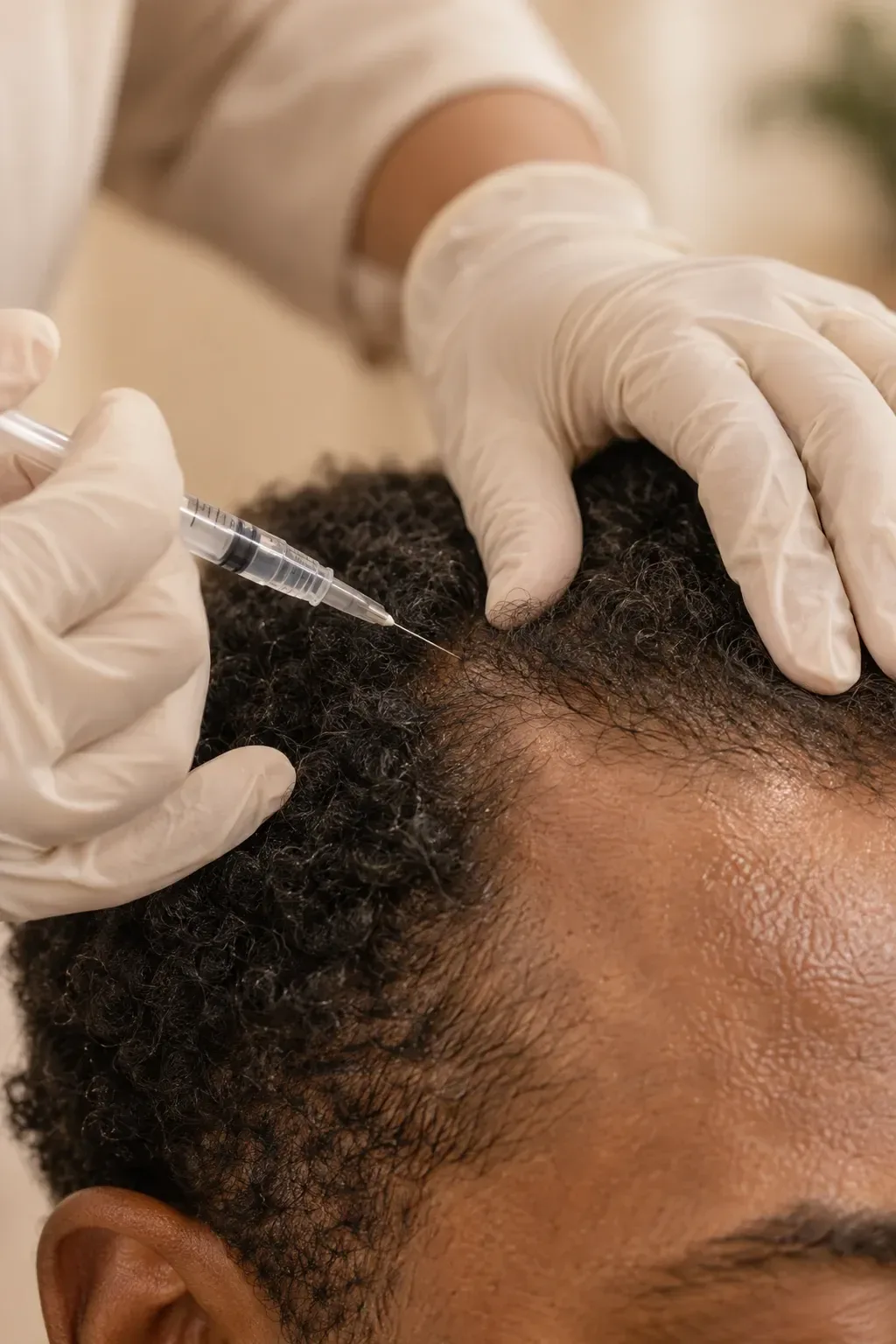
Injection
Dr. Hill or your provider places PRP with fine needles across the thinning areas of the scalp.
Aftercare Plan
You leave with aftercare instructions and a date for the next session in your series.
PRP Side Effects and Safety
PRP uses your own blood, so allergic reactions to the injected material are not expected.
Common, Short-Lived Effects
The most common effects are temporary: scalp tenderness, a tight or achy feeling, mild swelling that can drift toward the forehead, pinpoint bleeding and small bruises at injection sites. These usually settle within one to three days.
Less Common Risks
Less common risks include infection at an injection site, a short period of increased shedding and, rarely, lightheadedness during the blood draw.
Safety Standards and When to Call Us
PRP should be prepared with sterile, single-use kits. The U.S. Food and Drug Administration oversees blood products and the devices used to process them. Call us if pain, warmth or fever develops.
Cost
PRP Hair Treatment Cost in Atlanta, GA
Clear pricing at your consultation
How Much Does PRP for Hair Loss Cost in Atlanta?
The cost of PRP depends on the size of the area treated, the number of sessions, any combined treatments and maintenance needs. After your hair loss evaluation, your provider gives you exact pricing for your plan at the consultation.
Insurance and PRP for Hair Loss
PRP for hair loss is considered elective and is typically self-pay. The medical visit that diagnoses the cause of your hair loss, including lab work, may be covered by your plan. See accepted insurance plans.
Financing and Payment Options
To spread out the cost of a treatment series, SOCAH Center offers CareCredit and Cherry. Review PRP financing options with CareCredit and Cherry.
Why Choose SOCAH Center for PRP for Hair Loss in Atlanta, GA
Hair loss is our specialty
Dr. Hill built SOCAH Center around medical hair loss care. Every PRP candidate has a scalp evaluation first, so platelets are used for the type of hair loss most likely to respond, and progress is tracked with consistent photographs. If PRP is not the right fit, we explain why and what to try instead.
Diagnosis First
A hair loss workup confirms the cause before any PRP session is booked
Hair Loss Focused Team
Led by a dermatologist recognized for medical hair loss disorders
Combination Planning
PRP coordinated with prescriptions, salon scalp care and follow-up
Every Hair Type Welcome
Experience with curly, coily, relaxed, braided and straight hair
Progress Photographed
Consistent photos track density so results are measured, not guessed
Spanish-Speaking Care
Physician associate Tyrone performs evaluations and PRP in English or Spanish

Related Treatment
Revive Growth Factor Therapy
One growth factor treatment, three applications: thinning hair, tired skin and uneven tone.
- Three Uses in One
- Same Formula
- Gentle on Pigment
Hair Replacement for Men
Custom hair units matched to your texture, color and hairline, for a full look the same day.
- Same-Day Results
- No Surgery
- Matched to You
Microneedling
Collagen-building microneedling for smoother texture, softer scars and a more even tone.
- Your Own Collagen
- Gentle on Pigment
- Short Recovery
PRP Hair Treatment FAQs
How much does PRP hair treatment cost?
How long does a PRP session take?
Do PRP injections for hair loss hurt?
When will I see results from PRP?
How many PRP sessions will I need?
What is the difference between PRP and Revive Growth Factor Therapy?
Who is a good candidate for PRP for hair loss?
Does PRP work for traction alopecia?
Can I combine PRP with minoxidil or finasteride?
Schedule Your PRP for Hair Loss Consultation
References
- Cruciani et al., Blood Transfus. (2023). Platelet-rich plasma for the treatment of alopecia: a systematic review and meta-analysis. PMID: 34967722.
- Donnelly et al., J Cosmet Dermatol. (2024). The role of platelet-rich plasma in androgenetic alopecia: A systematic review. PMID: 38284294.
- Paichitrojjana et al., Drug Des Devel Ther. (2022). Platelet Rich Plasma and Its Use in Hair Regrowth: A Review. PMID: 35300222.
- Emer, Skin Therapy Lett. (2019). Platelet-Rich Plasma (PRP): Current Applications in Dermatology. PMID: 31584784.
- Gupta et al., J Dermatolog Treat. (2022). Comparison of oral minoxidil, finasteride, and dutasteride for treating androgenetic alopecia. PMID: 35920739.