

Dandruff and Itchy Scalp Treatment in Atlanta, GA: Relief for Flaking and Irritation, in Clinic and in Our Salon
Find the real cause of flaking and itch, then calm it with medical and salon care.
- Common In:
- Teens and adults, all hair types
- Primary Causes:
- Yeast, oil, buildup, psoriasis
- Treatment Time:
- 20-90 minute visits
- Results:
- Less flaking in 2-4 weeks


What Is Dandruff and an Itchy Scalp?
Recognizing the Signs
Dandruff is the visible shedding of skin cells from the scalp, usually with itching. It sits on a spectrum: mild dandruff causes fine, dry-looking flakes, while seborrheic dermatitis adds inflammation, greasy yellowish scale and redness that can spread to the eyebrows, sides of the nose, ears and chest. An itchy, flaky scalp can also come from scalp psoriasis, contact dermatitis or simple product buildup, and each needs a different plan.
When you notice white flakes on dark clothing, scale collecting along your part, or an itch that keeps you reaching for a comb between wash days, your scalp is telling you something is off. On lighter skin, irritated areas usually look pink or red. On deeper skin tones, seborrheic dermatitis may look darker, lighter or ashy rather than red, and it can form ring-shaped patches along the hairline.
People with curly and coily hair often wash less frequently to protect moisture, which lets scale and oils build up between washes, while frequent heavy oils and gels can add to the problem for any hair type. See how flaking fits among the other hair and scalp problems in our full conditions guide.
Medically reviewed by Dr. Nikki D. Hill, MD, FAAD. Last updated: October 2026.
Why Dandruff and Scalp Itch Happen
Understanding the Root Causes
01The Science
Your scalp normally renews its surface about once a month, shedding cells too small to see. In dandruff that turnover speeds up, so cells clump into visible flakes. The main driver is Malassezia, a yeast that lives on almost everyone's scalp. It feeds on scalp oil and releases fatty acids that irritate sensitive skin, triggering inflammation, itch and faster shedding. The American Academy of Dermatology overview of seborrheic dermatitis explains why the condition tends to come and go.
The irritation also weakens the scalp barrier, so moisture escapes and irritants get in more easily. That is why scratching, hot water and harsh products can keep the cycle going. Calming the yeast, removing excess scale and restoring the barrier all have to happen together for relief to last.
02Deeper Understanding
Seborrheic Dermatitis, Psoriasis or Buildup?
How Diagnosis Shapes Your Treatment
Flaking has several look-alikes. Seborrheic dermatitis brings greasy, yellowish scale with itch. Scalp psoriasis forms thicker, well-defined plaques with silvery scale that often extend past the hairline onto the forehead or behind the ears. Product buildup leaves waxy residue that rinses away more easily. Contact dermatitis from hair dye, relaxers or fragrance causes burning and itching after a new product. Scalp ringworm, more common in children, causes scaling with broken hairs and needs oral antifungal medicine.
At a medical visit we examine the scalp, use dermoscopy to look closely at scale and follicles, and ask about products and styling. Patch testing helps when an allergy is suspected, and a scraping or culture can confirm fungal infection. Our medical dermatology team handles this evaluation and any prescriptions.
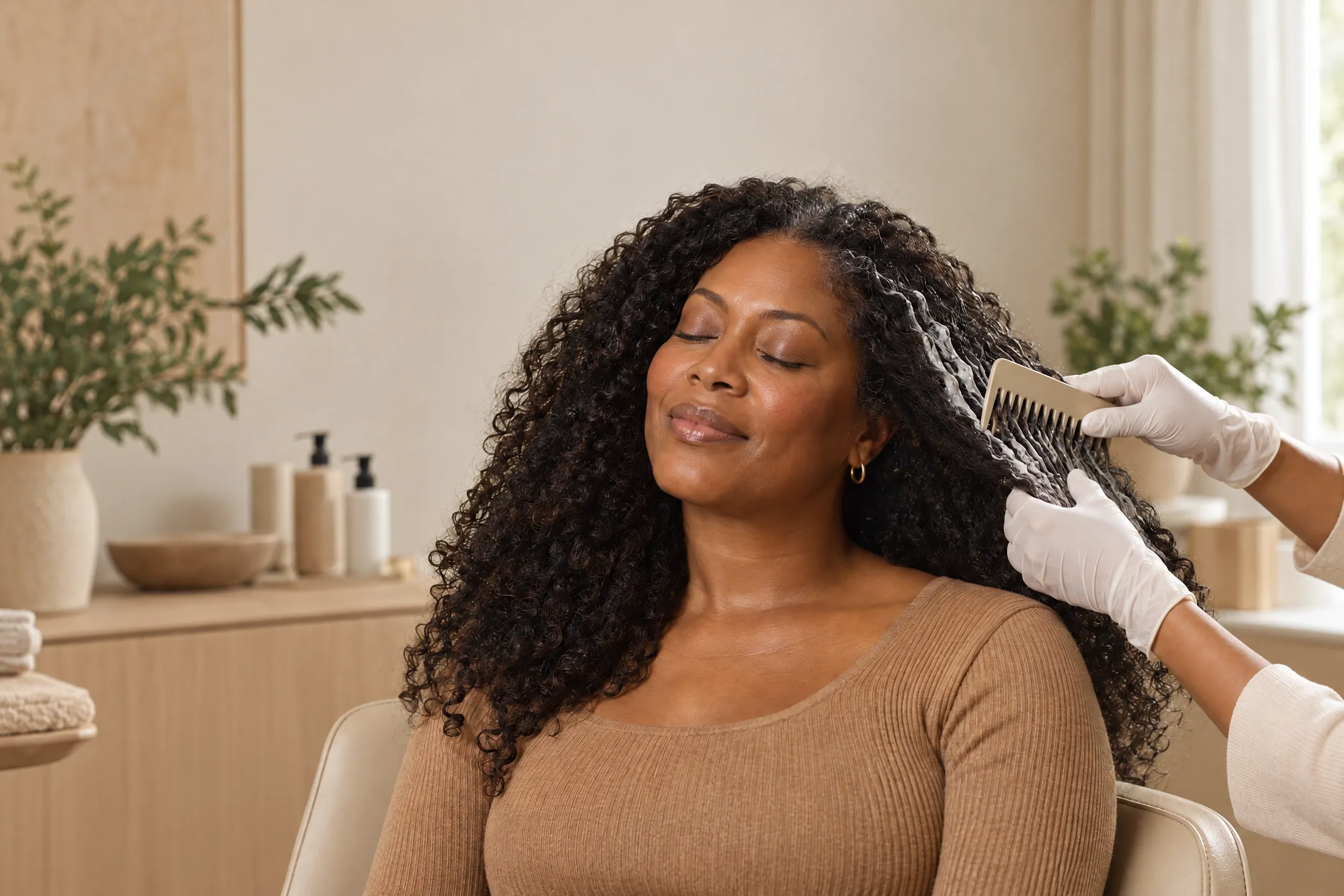
Once medical causes are addressed, salon care keeps the scalp clear. The salon's Dandruff Treatment, offered in our dermatologist-supervised hair salon, works alongside your medical plan, and for heavy residue a deep-cleansing scalp detox with the Calm Scalp step lifts buildup before it feeds the itch.
What Makes Dandruff and Itch Worse?
Flaking usually reflects several factors stacking up rather than one cause, which is why it tends to return without a plan.
- 01Yeast OvergrowthMalassezia thrives on oily scalps, and its byproducts trigger inflammation and faster shedding in people sensitive to it.
- 02Long Gaps Between WashesExtended wash cycles under braids, wraps or protective styles let oil, scale and yeast accumulate on the scalp.
- 03Heavy Oils and Styling ProductsThick oils, pomades and gels can coat the scalp, feed yeast and trap scale against the skin.
- 04Stress and Sleep LossFlares of seborrheic dermatitis commonly follow stressful periods, illness or poor sleep.
- 05Cold, Dry WeatherWinter air and indoor heating dry the scalp barrier, so many people notice more flaking from late fall to spring.
- 06Underlying Skin ConditionsPsoriasis, eczema and allergic contact dermatitis can all look like dandruff and need their own treatment.

Why Choose SOCAH Center for Dandruff & Itchy Scalp Care in Atlanta, GA
Few practices offer a dermatologist and a medical hair salon under one roof. Board-certified dermatologist Dr. Hill and her team diagnose the cause and prescribe when needed, then our salon team keeps your scalp clear with care matched to your hair type. Patients come from Decatur, Tucker, Chamblee and across metro Atlanta.
- Clinic and Salon Together
- Medical diagnosis and salon scalp care are coordinated so both plans support each other.
- Every Hair Type
- Recommendations fit straight, wavy, curly and coily hair, natural or chemically treated.
- Accurate Diagnosis
- Dermoscopy, patch testing and cultures separate dandruff from psoriasis, allergy and infection.
- Routine-Friendly Plans
- Wash schedules and products are built around your styling routine, not against it.

Treatment Options Comparison
Salon care works best once a medical cause has been ruled out or treated, and many patients use both.
| Treatment | Best For | Session Time | Results Timeline | Maintenance |
|---|---|---|---|---|
| Scalp Detox Treatment | Heavy buildup and itch | 60-90 min | After one visit | Every 4-8 weeks |
| Medical Hair Salon | Ongoing dandruff upkeep | 45-60 min | 1-2 visits | As recommended |
Signs of Dandruff or an Irritated Scalp
If over-the-counter shampoos have not helped after a few weeks, or the signs below keep returning, a professional evaluation can identify what is driving them.
Visible Flakes
You see white or yellowish flakes on your shoulders, collar or pillow, even soon after washing.
Persistent Itch
Your scalp itches enough to distract you at work or wake you at night, especially between wash days.
Greasy Scale
Scale feels oily and sticks to the scalp or along the part, rather than brushing away easily.
Thick Plaques
You feel raised, crusted patches at the hairline or behind the ears that bleed when picked.
Facial Flaking
Flaking or discoloration also appears in your eyebrows, beside your nose or in your beard.
Burning After Products
Your scalp stings or itches after a new dye, relaxer or styling product.


Related Treatment
Scalp Detox Treatment
A deep-cleansing scalp treatment for every hair type, supervised by a dermatologist.
- Deep Clean
- Calmer Scalp
- Gentle Exfoliation
Deep Conditioning Treatment
Our Hydrate and Repair treatment brings softness, strength and shine back to every hair type.
- Lasting Moisture
- Stronger Strands
- Length Retention
Skin Tag Removal
Fast, precise removal of skin tags by a dermatology team, with care for every skin tone.
- One Short Visit
- Minimal Scarring
- Accurate Diagnosis
Frequently Asked Questions
Is dandruff the same as seborrheic dermatitis?
Which shampoos help dandruff?
How often should I wash my hair if I have dandruff?
What prescription treatments are available?
Can dandruff cause hair loss?
How is the salon Dandruff Treatment different from a scalp detox?
Is dandruff treatment covered by insurance?
Schedule Your Dandruff & Itchy Scalp Treatment Consultation
Scientific References
- Clark et al., Am Fam Physician. (2015). Diagnosis and treatment of seborrheic dermatitis. PMID: 25822272.
- Borda et al., J Dermatolog Treat. (2019). Treatment of seborrheic dermatitis: a comprehensive review. PMID: 29737895.
- Turner et al., Int J Cosmet Sci. (2012). Stratum corneum dysfunction in dandruff. PMID: 22515370.
- Jackson et al., J Am Acad Dermatol. (2024). Unmet needs for patients with seborrheic dermatitis. PMID: 36538948.
- LeFevre et al., Am Fam Physician. (2025). Seborrheic Dermatitis: Diagnosis and Treatment. PMID: 40834373.